
Threading Together History
The Story of American Colonial Sewing Samplers

In the delicate stitches of an embroidered sampler, we find not just decorative needlework, but a window into the lives, education, and values of young women in early America. The earliest known surviving American sampler dates to the seventeenth century, created by Loara Standish, daughter of Mayflower passenger Myles Standish, establishing a needlework tradition that English women had carried across the Atlantic to the New World.
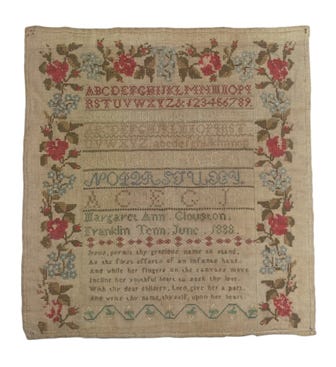
Margaret Clouston’s 1838 sampler, with its carefully stitched biblical verses, exemplifies how samplers served secondary functions as girls sewed verses, poems, or tracts about life and death and the rewards of pious behavior. As governess to the McGavock children at Carnton Plantation, “Mag” embodied the intersection of education, faith, and feminine accomplishment that samplers represented.
These embroidered textiles were far more than simple craft projects. By the 1700s, samplers depicting alphabets and numerals were worked by young women to learn basic needlework skills needed to operate the family household. Girls as young as five or six began with marking samplers, learning to stitch alphabets and numbers in cross-stitch—practical skills essential for marking household linens, which were among a family’s most valuable possessions.
By the late 1700s and early 1800s, schools or academies for well-to-do young women flourished, and more elaborate pieces with decorative motifs such as verses, flowers, houses, and religious, pastoral, or mourning scenes were being stitched. These ornamental samplers served a crucial social function, revealing not just a girl’s technical skill but her family’s values and social standing to potential suitors.
The religious content so prominent on samplers like Margaret Clouston’s reflected the central role of faith in female education. Sampler making was seen as laying the groundwork for religious piety, family responsibility, and civic virtue. Female academies deliberately created environments promoting modesty and virtue, and the execution of verses on samplers provided practice for intricate stitches while fostering virtue, publicly exhibiting moral and needlework accomplishments.
What makes samplers particularly valuable historically is their documentary nature. Girls usually signed their samplers, stitching their name, age, and the date the sampler was completed, and these small bits of embroidered cloth are often all that remains to testify to the otherwise unrecorded lives of their makers. Many samplers are inscribed with locations and the names of teachers and schools, providing researchers with tangible evidence about institutions and individuals who might otherwise be lost to history.
Every sampler is a historical record of one girl’s educational training and the type and value placed on that education, with the overall design, materials used, and design motifs giving evidence of her culture, religion, social class, and personal artistic accomplishments. For wealthy families, samplers confirmed genteel standing; for middle-class families, they established social position; for poor or orphaned girls, samplers demonstrated marketable sewing skills for future employment.
In an era when education was not widely available to most people in the colonial period, and girls in families that could afford it received instruction in various female accomplishments, samplers became perhaps the most tangible evidence of female education at the time. They represent both the limitations placed on women’s education and the creativity and skill that flourished within those constraints.
Today, samplers have become important in museum collections as representations of early American female education, and the appreciation of and scholarship in needlework samplers for their beauty, evidence of early women’s history, and educational methodology has led to increased interest in this form of female expression into the twenty-first century. When we view Margaret Clouston’s sampler at Carnton Plantation or study other surviving examples, we’re not merely admiring antique needlework—we’re honoring the voices, labor, and aspirations of generations of young women who left their mark on history, one careful stitch at a time.
Sources:
National Museum of American History: https://americanhistory.si.edu/collections/object-groups/american-samplers
Milwaukee Public Museum: https://www.mpm.edu/research-collections/history/online-collections-research/schoolgirl-samplers
National Archives: https://www.archives.gov/publications/prologue/2002/fall/samplers-1.html
The Metropolitan Museum of Art: https://www.metmuseum.org/essays/american-needlework-in-the-eighteenth-century
Exhibition information: https://www.facebook.com/share/1G1ARzKjRP/