
The Silent Artisans
Whitesmiths and Brownsmiths in the Age of Colonial Innovation

I was interested in this topic as I was researching for my Book “American Invention - Enlightenment to Innovation”. This article is a more than I used in the book, but the information and learning I thought I would share with you.
The Quiet Workshop Next Door
Walk past any colonial blacksmith’s forge and your senses would be assaulted by the theatrical drama of the metalworking trades—the roaring bellows pumping air into glowing coals, the rhythmic clang of hammer against anvil, the hiss and sizzle of red-hot iron plunged into cooling water, and the acrid smell of burning coal mixing with the metallic tang of hot steel. Yet just next door, in a workshop that seemed almost genteel by comparison, another kind of metalworker practiced an entirely different art.
Here, the din of tin was nowhere near as loud as the blacksmith’s trade—just the squeak of shears cutting sheet metal, the tap of a hammer, and the muffled thump of a mallet. This was the domain of the whitesmith, a craftsman whose work emphasized precision and polish over brute force, finesse over fire. While blacksmiths fought with iron at temperatures that could melt stone, whitesmiths coaxed beauty from metals that required no heat at all, shaping thin sheets of tin, pewter, and occasionally silver into objects that graced homes from Boston to Charleston.
The Birth of a Trade: From Bohemian Innovation to Colonial Necessity
Whitesmithing, or tinsmithing, was invented in the 13th or 14th century in Bohemia, making it a relatively modern profession compared to the ancient arts of blacksmithing and bronze-working that stretched back to humanity’s first experiments with metallurgy. Central Europe held a monopoly on the production of tinplate, with all tin goods available to greater Europe being manufactured and shipped from Germany. This status quo remained until the 30 Years’ War, which disrupted production in many industries and forced countries to start crafting their own tin goods or do without.
Britain began manufacturing its own tinplate, albeit slowly and inefficiently. It wouldn’t be until the invention of the rolling mill in 1728 that tinplate could be made easily. This technological breakthrough would prove crucial for the development of the British tin industry, but it would also create tensions that would contribute to colonial grievances leading to revolution.
Imperial Control and Colonial Defiance
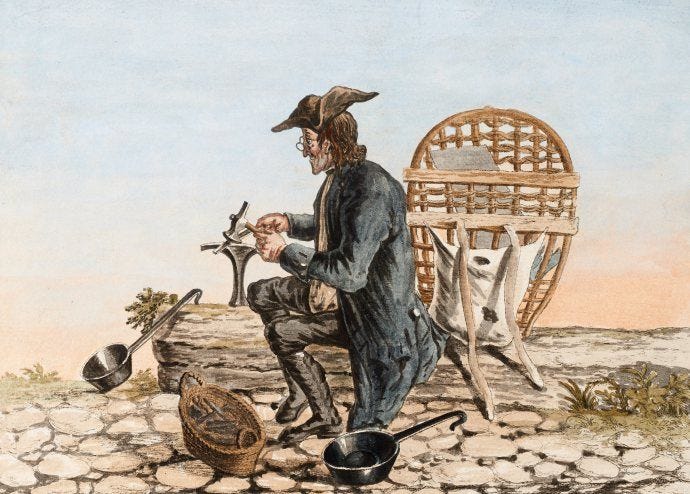
The story of whitesmithing in colonial America cannot be separated from the larger narrative of British imperial economic policy and the growing resentment it fostered among American colonists. In the early 1700s, Britain banned production of tinplate and tinware in its Colonies to encourage dependence on imports. Tinplate consists of sheet iron coated with tin and then run through rollers. The British Iron Act of 1750 prohibited the erection of rolling mills in America.
This prohibition was no mere bureaucratic oversight but rather reflected calculated imperial strategy. The export of tinplated steel and tin products was so important to the British economy that Parliament did what they could to keep tin and smithing supplies out of the hands of the Colonies (especially in America). The economic logic was clear to British administrators: by forcing colonists to purchase finished tin goods from British manufacturers, Parliament ensured a captive market for English industry while preventing the development of competing colonial manufacturing capacity.
Yet the prohibitions rested on a fundamental misunderstanding of both colonial resourcefulness and the practical necessities that drove American demand for tin products. Tin’s light weight and durability made it the ideal material for an army on the move or any population where goods had to be shipped on rough roads over long distances. Furthermore, because of its bright appearance, mimicking silver, middle class demanded affordable yet beautiful goods to imitate those of the upper class, these were typically made from tin.
Despite the restrictions of Parliament, whitesmithing shops still managed to crop up in the Colonies. Tinsmiths, like Edmond Pattison, an immigrant Scot, living in Berlin, Connecticut, emerged to meet this demand. He was colonial America’s earliest tinsmith of record, producing what were probably the first hand made tin plated household utensils produced in the American colonies.
The Whitesmith’s Art: Mathematics, Precision, and Beauty
What distinguished whitesmithing from other metalworking trades was not just the materials used but the entirely different skill set it required. Pure tin is an expensive and soft metal and it is not practical to use it alone but its non-rusting qualities make it an invaluable coating. Tin can also be alloyed with lead and copper to make pewter or alloyed with copper alone to produce bronze.
Although working tinplate was physically easier than blacksmithing, an adequate knowledge of whitesmithing required math, precision, and aesthetic know how in order to shape flat sheets of tin into three dimensional, functional, and beautiful items. Unlike blacksmiths who relied on strength, stamina, and an almost intuitive feel for how hot metal responded to the hammer, whitesmiths needed to visualize how flat patterns would transform into three-dimensional objects, calculate precise angles and measurements, and execute their designs with mathematical accuracy.
The creation of tinware was also relatively low maintenance compared to other metalworking professions like blacksmithing that required large workspaces and heavy equipment. In contrast, a tinsmith could work over a small, lightweight anvil with basic tools like hammers, tin snips, punches, shears, and soldering rods. This relative simplicity of equipment belied the sophistication of the work being performed. Each piece began as a flat sheet of tinplate—thin sheets of iron coated with molten tin—that had to be traced, cut, shaped, and joined with such precision that seams would be watertight and forms would be both functional and pleasing to the eye.
The Long Apprenticeship: Learning the Trade
For these reasons, whitesmithing was a trade traditionally taught through apprenticeships which usually lasted around four to six years. Colonial tinsmiths learned their trade through apprenticeships starting at around age 15, entering into formal agreements that bound them to master craftsmen who would teach them not just the mechanical techniques of the trade but also the mathematical principles, aesthetic sensibilities, and business practices needed for success.
The apprentice tinsmith’s education began with the simplest tasks—cleaning tools, organizing materials, maintaining the workshop—and gradually progressed to more complex responsibilities. They learned to trace patterns accurately, mastering the geometric relationships that allowed flat sheets to become cylinders, cones, and complex curved forms. They practiced cutting techniques until they could work swiftly with tin snips and shears, leaving clean edges that required minimal filing. They studied the properties of different metals and alloys, understanding when to use tin-coated iron versus pure pewter, when to employ copper rivets versus tin solder.
According to Colonial Williamsburg’s master tinsmith Steve Delisle, the trickiest task they’d learn was soldering: “In the eighteenth-century, tinmen usually joined seams by soldering. They used an iron soldering rod with a copper head that was placed in a charcoal brazier. An artisan making a cup would bend a piece of metal to form its cylinder and then would put the ends together to form a smooth, watertight seam. A tin-alloy solder was placed on it. In the seconds before the copper head cooled after leaving the fire, the tinman had to solder the seam shut. He had to work quickly, relying on the right rhythm and steady hands”.
This soldering technique represented the culmination of the whitesmith’s art—a process that required perfect timing, steady nerves, and the kind of hand-eye coordination that could only be developed through hundreds of hours of practice. A botched soldering job could ruin hours of careful preparation, creating leaks in containers or weak joints that would fail under stress.
The Workshop: Division of Labor and Specialization
After completing an apprenticeship, tinsmiths sought employment at established whitesmith shops or opened their own. The average shop possessed at least one tinsmith but could have three or more during busy times. In most whitesmith shops, each smith was assigned a specific task depending on their experience and specific expertise.
During the Revolutionary War period of 1778-80, perhaps three or more men toiled at Williamsburg’s tin shop. “One man may have traced patterns onto sheets of metal and cut out the parts. Another craftsman could have shaped these into components and done some basic assembly, while a third person would do the final assembly and soldering”.
This division of labor represented an early form of production-line manufacturing, presaging the industrial organization that would later transform American manufacturing. By breaking complex tasks into specialized steps, tinsmith shops could achieve both greater efficiency and higher quality. The least experienced worker might trace and cut patterns under supervision, gradually developing the accuracy needed for more complex work. An intermediate craftsman would handle shaping and preliminary assembly, tasks that required good technique but allowed for some adjustment and correction. The master craftsman reserved for himself the final assembly and soldering—the critical steps where mistakes could not be easily remedied and where the piece’s quality would ultimately be judged.
Revolutionary Necessity: Tinsmithing in Wartime
The Revolutionary War created unprecedented demand for tin products while simultaneously disrupting the supply chains that had previously provided them. The military wanted tin items, because they were inexpensive, lightweight, and durable. The tinware the American navy and army needed wasn’t easy to get. Until the war, most tin items came from England. Relatively few tinmen lived in the colonies, and supplies of raw material were limited by the British blockade.
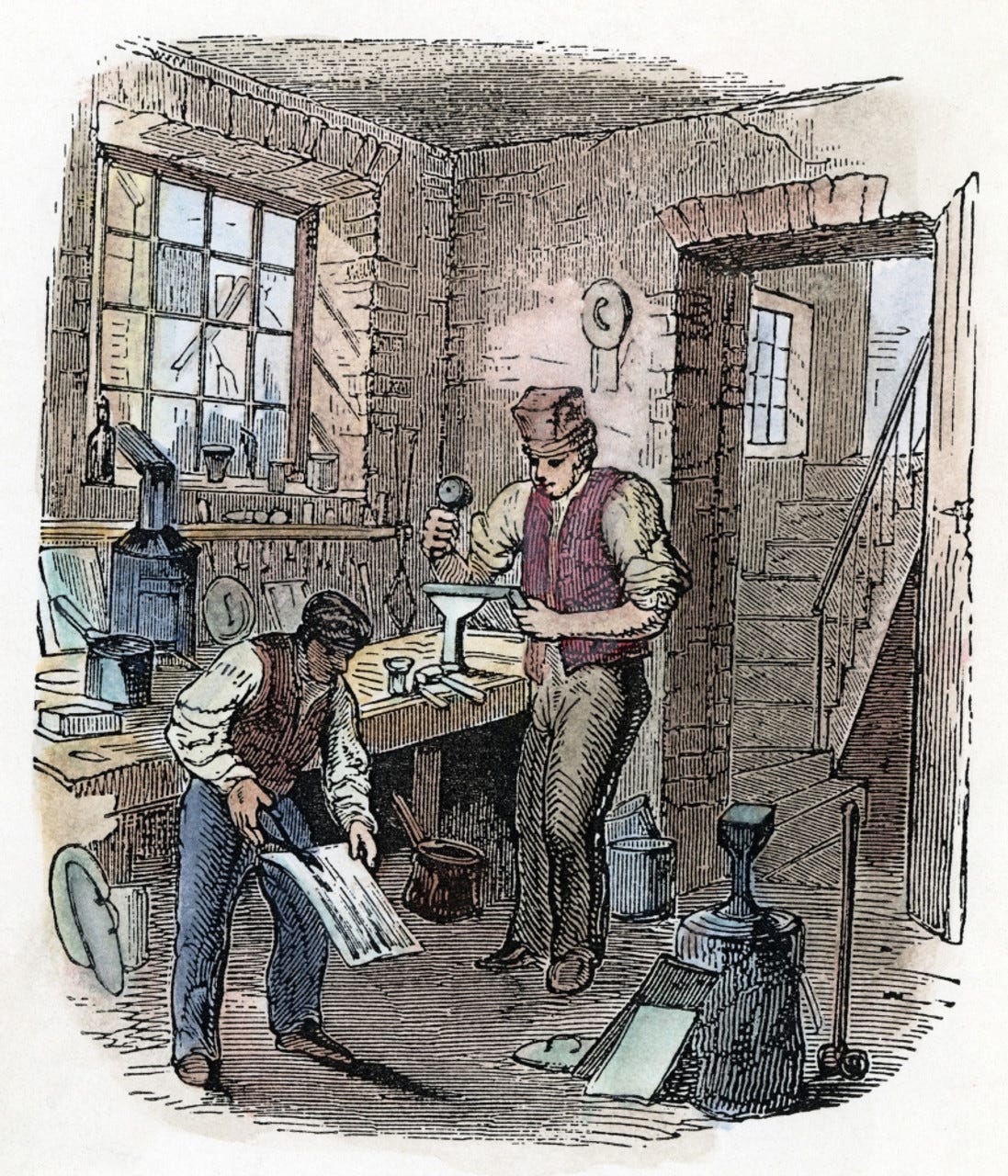
Part of Anderson’s Blacksmith Shop and Public Armory, the Tin Shop helps to show that Williamsburg was an eighteenth-century arsenal of the American cause. Like blacksmiths and gunsmiths at the gritty Anderson industrial site, tinsmiths worked on military gear, producing such things as canteens, cups, kettles, saucers, lanterns, and speaking trumpets.
These military applications of tinsmithing revealed the strategic importance of what might have seemed like a humble domestic craft. A soldier’s canteen, properly made from tin-plated sheet iron, could carry water reliably through long marches without adding excessive weight to an already burdened infantryman. Tin lanterns provided portable lighting that wouldn’t shatter like glass or rust like iron. Speaking trumpets—conical devices that amplified human voices—enabled officers to communicate commands across the chaos of battlefields. Each of these items required the whitesmith’s particular combination of precision and practicality.
The Brownsmith’s Domain: Brass and Copper
While whitesmiths worked the bright, silvery metals, their colleagues the brownsmiths—also known as coppersmiths or redsmiths—specialized in the warm, golden tones of brass and copper. A brownsmith works with copper and brass. The term coppersmith is often used interchangeably with brownsmith, and each of these are also referred to as redsmiths. Brownsmiths craft a range of products like cookware, jewelry, decorative home items, hardware, sconces, and more.
Copper is generally considered to be a soft metal, meaning it can be worked without heating, giving brownsmiths an advantage similar to that enjoyed by whitesmiths—they could work their materials cold, without the massive forges and bellows required by blacksmiths. Yet copper presented its own technical challenges. Over a period of working the metal in this way it can “work-harden”. This means that the atoms within the copper are compressed and irregular in their arrangement. This causes stress in the metal and eventually cracking the metal along these stress points.
In order for the copper to be worked to any extensive degree it must be annealed. This process involves heating the metal and then rapidly cooling it in water. The cooling stage is known as quenching. By heating the copper, the atoms in the metal are relaxed, and thus able to align themselves in a more uniform fashion. This allows for easier shaping of the metal. This annealing process represented sophisticated metallurgical knowledge, an understanding of how metal’s internal structure affected its working properties.
Imperial Restrictions on Copper and Brass
Like tinsmithing, coppersmithing in colonial America operated under significant British restrictions. By the 1700s, coppersmiths lived in the American colonies, but did not have access to much sheet copper due to the British Crown’s regulation of copper and other goods to the Americas. Sheet metal production was prohibited in the colonies as well before the American Revolution.
Early colonial America lacked domestic production facilities, so brass was primarily imported. Despite this, brass items such as candlesticks, doorknobs, and household utensils were highly popular — people wanted more and more. One of the earliest brass founders in America was Joseph Jenks, who operated in Lynn, Massachusetts, from 1647 to 1679, producing brass pins for the wool-making industry.
Before the Revolution, it had been in Britain’s interest to encourage raw mining in early America while forbidding manufacturing. But the British did not take into consideration the extraordinarily mixed populations in some of the colonies, immigrants who brought with them skills learned in the late Renaissance guild traditions. Americans were perfectly capable of doing not only the mining but the smelting, casting, and finishing of all metals.
This immigrant expertise would prove crucial for American independence. That they were forbidden by British law from doing so eroded their loyalty to the British Empire and contributed to the growing movement for independence. The restrictions on metalworking were not merely economic inconveniences but represented a fundamental British misunderstanding of colonial aspirations and capabilities—a miscalculation that would contribute to the empire’s loss of its most valuable American possessions.
The Aesthetic Imperative: Brass in Colonial Life
Brass held particular appeal in colonial households not just for its functional properties but for its visual impact. Before electricity and artificial lighting, metal objects were themselves points of light—shining accents in dim spaces. Drawer handles, fireplace andirons, and candlesticks were kept as clean and polished as possible to glisten even as they served commonplace purposes. Brass sconces, mounted on the wall, threw candlelight back into the room, to be reflected in mirrors.
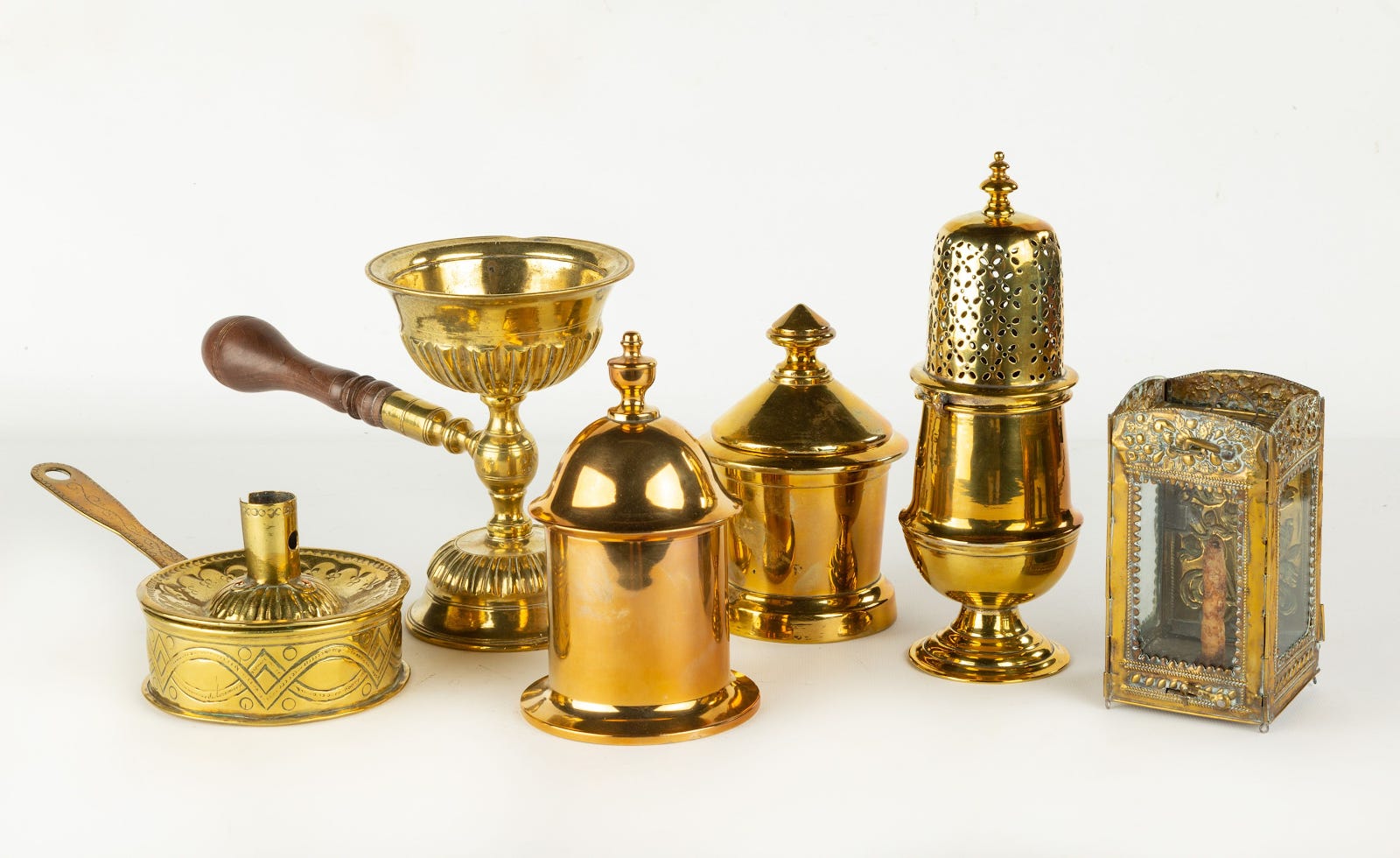
The aesthetic dimension of brass and copper work represented more than mere decoration—it embodied aspirations toward refinement and gentility in a rough colonial environment. The emerging middle class of 18th-century America sought to emulate the material culture of their social superiors, and brass provided an affordable means of achieving visual effects that approached the glory of silver without requiring comparable wealth.
Colonial instrument makers worked with brass to create surveying instruments of remarkable beauty and precision, though sockets, sight vanes, and items of this nature were made on quite a small scale which was sufficiently strong to produce the desired rigidity but not of the massiveness of the English instruments from the same period where brass was much more available. These colonial brass instruments demonstrated that material scarcity could inspire innovation rather than simply limiting achievement—American craftsmen developed lighter, more elegant designs that accomplished the same functions with less material.
The Training of Brownsmiths
In the 1700 and 1800s, coppersmiths typically had a few apprentices in various stages of learning the trade working together, creating workshop environments that fostered skill development through observation and practice. Apprentice brownsmiths learned not just metalworking techniques but also the chemistry of alloys, the physics of heat transfer, and the aesthetics of proportion and decoration.
The range of products created by colonial brownsmiths encompassed both utilitarian and decorative applications. Cooking vessels made from copper offered superior heat distribution compared to iron, making them prized by serious cooks despite their higher cost. Brass and copper fittings for furniture, doors, and cabinets added both functionality and visual interest to woodwork. Decorative objects like candlesticks, sconces, and ornamental hardware demonstrated the brownsmith’s ability to combine practical function with aesthetic appeal.
Urban Concentration and Market Dynamics
Philadelphia emerged as one of the earliest hubs for brass foundries due to its industrial activity and port access. However, there were other early hubs for brass production, including Waterbury, Connecticut, Lynn, and Massachusetts. These urban concentrations reflected both supply and demand factors—port cities provided access to imported metals and materials, while concentrated populations created markets for refined metal goods.
The urban location of most whitesmith and brownsmith workshops also reflected the social and economic positioning of these trades. Unlike blacksmiths who might establish forges in rural areas to serve agricultural communities, whitesmiths and brownsmiths depended on clientele who could afford refined metal goods and who valued aesthetic as well as functional qualities. Their workshops became fixtures of colonial urban life, occupying spaces in commercial districts where their products would catch the eyes of passing customers.
Legacy and Transformation
The specialized metalworking trades of whitesmithing and brownsmithing flourished from the late medieval period through the 19th century, serving the domestic, decorative, and industrial needs of developing societies on both sides of the Atlantic. Their practitioners demonstrated that metalworking encompassed far more than the dramatic forge-work of blacksmiths—it also included the patient, precise, mathematically informed craftsmanship of those who worked with lighter metals and finer tolerances.
European techniques and expertise played a crucial role in establishing the brass industry in America. Skilled immigrants from Europe brought valuable knowledge of brass production, which American producers adapted to local resources and demands. This exchange of knowledge allowed brass-making to become what it is today.
Though industrialization eventually absorbed many functions of traditional whitesmiths and brownsmiths into mechanized manufacturing processes, the legacy of these crafts survives in artisanal metalwork and restoration trades today. Modern practitioners who repair antique tin lanterns, restore colonial brass hardware, or craft reproduction pewter vessels are maintaining traditions that stretch back through centuries of metalworking innovation.
More importantly, the story of whitesmiths and brownsmiths in colonial America illuminates broader themes about technology, economics, and political development in the revolutionary era. The British attempts to monopolize metal production and prohibit colonial manufacturing helped create the grievances that fueled independence movements. The resourcefulness of colonial craftsmen who overcame material shortages and legal restrictions demonstrated the innovative capacity that would characterize American industry. The integration of European craft traditions with American conditions and resources established patterns of technological adaptation and improvement that would drive American economic development for generations.
In the quiet workshops where tin squeaked under shears and copper glowed from annealing fires, colonial whitesmiths and brownsmiths were not just making household goods and military equipment—they were helping to forge the material culture and economic independence that would sustain a new nation.
Citations and Sources
Whitesmithing/Tinsmithing:
Colonial Williamsburg Foundation. “The Tin Shop.” https://research.colonialwilliamsburg.org/Foundation/journal/autumn13/tinsmith.cfm
Working the Flame. “The Life of a Tinsmith in Colonial America.” https://workingtheflame.com/tinsmithing-in-colonial-america/
Pierson, George, “The American Tinsmith, Dec 2017, The Tool Shed, A Journal of Tool Collecting published by CRAFTS of New Jersey, No #190, https://craftsofnj.org/images/sitemedia/toolshed/Tool-Shed-190_12-2017.pdf
Michael Carver Historical Interpreter. “The Whitesmith or Tinsmith.” https://colonialbrewer.com/the-whitesmith-or-tinsmith/
Crazy Crow Trading Post. “Early American Tinware: From Eastern Colonies to The American West.” https://www.crazycrow.com/site/early-american-tinware/
Wikipedia. “Tinsmith.” https://en.wikipedia.org/wiki/Tinsmith
Brownsmithing/Coppersmithing:
Working the Flame. “Types of Smiths Throughout History.” https://workingtheflame.com/types-of-smiths/
Wikipedia. “Coppersmith.” https://en.wikipedia.org/wiki/Coppersmith
Drawn Metal Tube. “History of Brass Manufacturing in America.” https://drawnmetal.com/history-of-brass-manufacturing-in-america
Copper.org. “Brass Colonial Instruments.” https://www.copper.org/consumers/arts/2007/october/Art_Brass_Colonial_Surveying_Instruments.html
Occupations: a preliminary list, by Culling, Joyce, Publication date 1999, page 50
ISBN 1860061036, The Book of Bmith, Publication date 1978
Page 166 — BROWNSMITH-—Signifies the smith who did es bright or burnished work and is opposite to blacksmith. Also defined as one who — worked in copper and brass. In some cases, it may refer to the — smith who made the brownbills, a two-edged sickle-shaped knife — or sword, weighing from nine to twelve pounds, on a handle: three or four feet long, and wielded with both hands with terrible _ power.
https://archive.org/details/bookofsmith0000unse/page/166/mode/2up?q=brownsmith
COLONIAL OCCUPATIONS, Our early American colonists did not have quite the same employment opportunities as we do today
BROWNSMITH: a person who worked with copper or brass
The Difference Between a Blacksmith, Whitesmith, Brownsmith, Redsmith [Medieval Professions: Smith], YouTube - Kobean History
Colonial Metalworking Context:
U.S. Department of State Diplomatic Reception Rooms. “Materials Spotlight: Silver & Other Metals.” https://www.diplomaticrooms.state.gov/materials-spotlight-silver-other-metals/
SNAG (Society of North American Goldsmiths). “Pewter: A Most Misunderstood Metal.” https://snagmetalsmith.org/2025/01/pewter-a-most-misunderstood-metal/
History for Kids. “Metalworking.” https://www.historyforkids.net/metalworking.html/
Britannica. “Metalwork - American Indian, Crafts, Art.” https://www.britannica.com/topic/metalwork/American-Indian-peoples